
Tower of Love
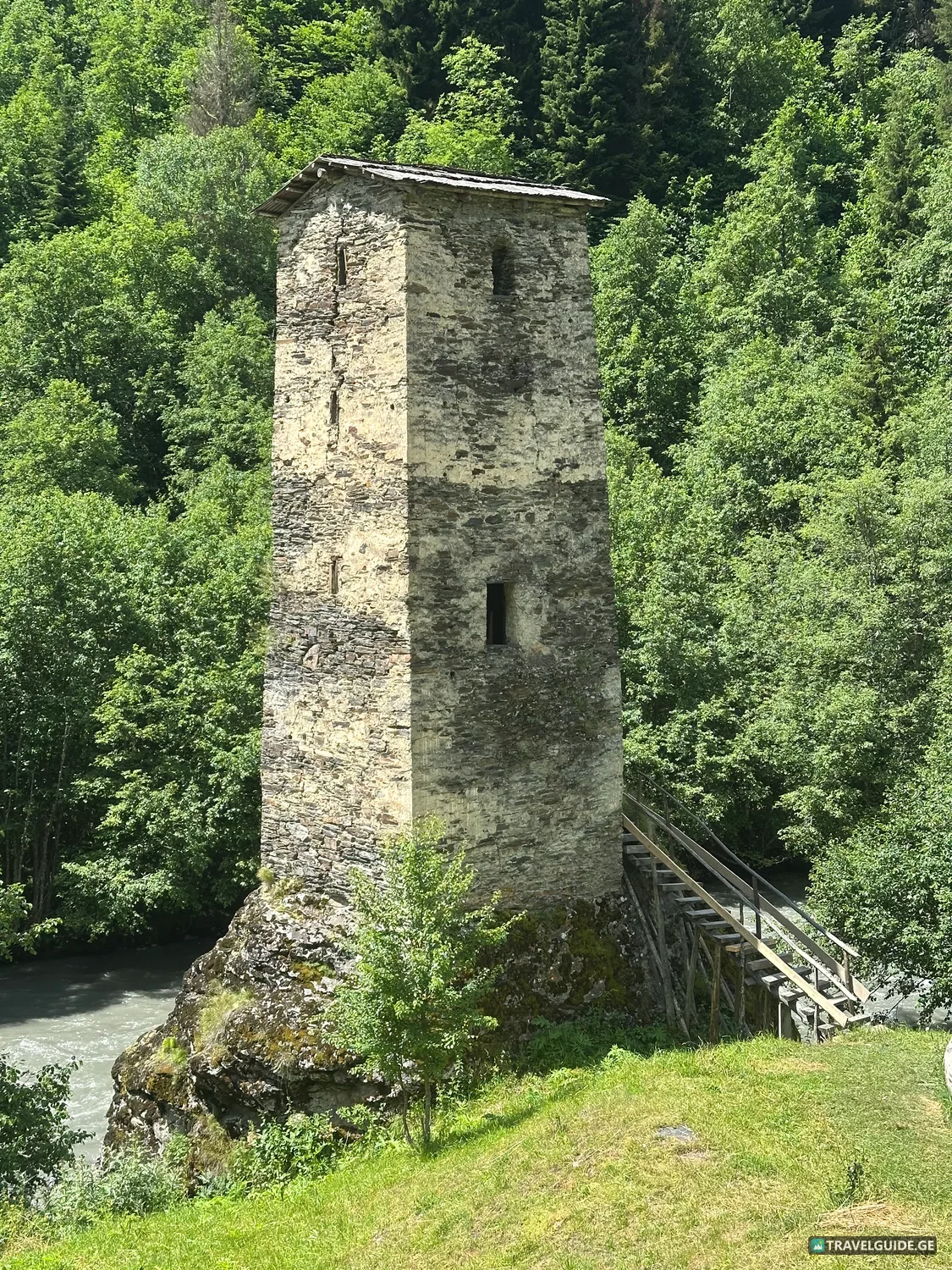
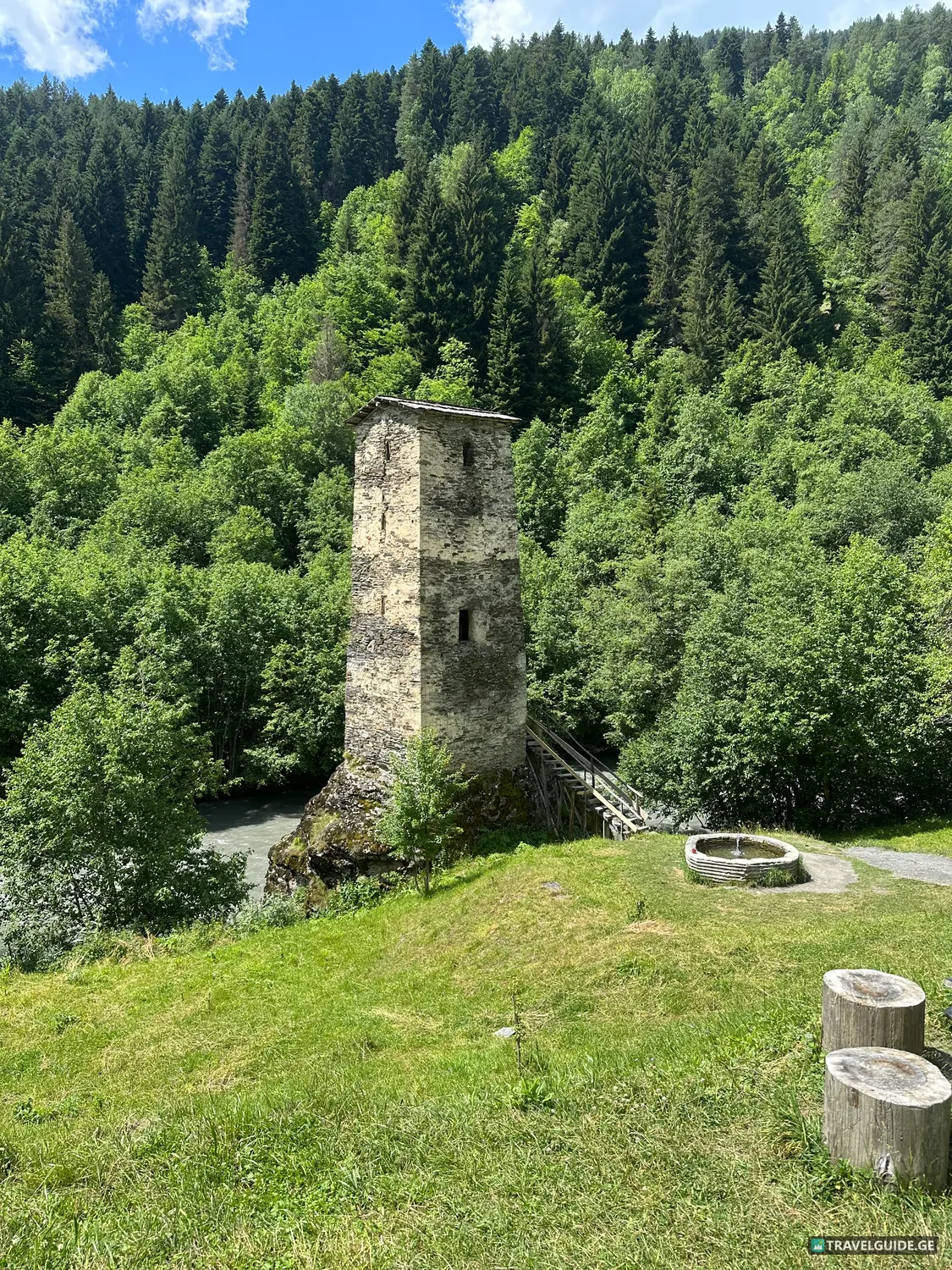
Standing isolated in the powerful currents of the Enguri River, the Tower of Love—known locally as Sikvarulis Koshki—is a striking vertical anomaly in the otherwise horizontal flow of the gorge. Located near the community of Bogreshi in Upper Svaneti, this ancient stone structure breaks all conventional rules of regional highland planning. While typical medieval Svan settlements group defensive towers tightly together to protect an entire clan, this solitary monolith was erected directly on a rocky outcrop beaten by relentless river rapids.
The structure immediately provokes questions regarding its utility, placement, and survival. Rising sharply against a dense backdrop of alpine forests and sheer cliff faces, the tower bridges the divide between rigorous military architecture and enduring local myth. Its dark, slate-grey stones blend effortlessly into the surrounding riverbed, yet the precise, tapering geometry of the structure marks it clearly as a product of intentional, sophisticated human engineering.
Scholars and historians place the construction of this isolated pillar somewhere between the 9th and 12th centuries, during the golden age of the Georgian kingdom. Although modern interpretation frequently leans heavily on oral traditions and romanticized narratives, a thorough geographical and historical analysis reveals a highly advanced multi-purpose fortification designed to control one of the most critical arteries in the Caucasus Mountains.
Strategic Control of the Enguri Gorge
Far from being merely a monument of isolation, the Tower of Love occupied a crucial node in the medieval communication network of Zemo Svaneti. The valley road along the Enguri River served as the primary transit route linking the regional center of Mestia with the remote, high-altitude settlements of Ushguli.
- Early Warning System: By positioning a watchtower in the narrowest section of the river gorge, sentries could maintain a clear line of sight over miles of approaching terrain.
- Signal Fires: In the event of an impending invasion from lowland forces or neighboring tribes, guards would light beacons on the flat roof of the tower. This smoke or fire signal would be instantly visible to the next tower along the valley, triggering a rapid chain reaction that alerted the upper highlands.
- Choke Point Defense: The steep walls of the gorge forced any advancing party to pass directly beside the river, bringing them within striking distance of the tower's defensive embrasures.
Architectural Mastery and Material Composition
The survival of the Tower of Love over nearly a millennium demonstrates the unparalleled stonemasonry skills of the indigenous Svan populations. The structure is an evolution of the traditional murkvam (the Svan word for a defensive tower), adapted specifically for a volatile riparian environment.
Constructed entirely from locally quarried schist and river stones, the builders utilized a specialized dry-stone technique fortified with a sparse application of indigenous lime mortar. The foundation is directly anchored into a massive river boulder, utilizing the natural bedrock to resist the erosive friction of the Enguri River during the violent spring snowmelt. The walls taper gradually as they rise; this sloped profile lowers the center of gravity, significantly improving the building's resilience against the frequent seismic tremors that shake the Greater Caucasus. The exterior walls are largely solid, pierced only by narrow, inward-beveled arrow slits that allowed defenders to fire projectiles while remaining completely shielded from incoming attacks.
The Folklore of Forbidden Romance
While military historians focus on the tactical value of the structure, local oral traditions offer a deeply humanized explanation for its solitary existence. According to the most prominent Svan legend, the tower was commissioned by a wealthy nobleman for his grief-stricken daughter.
The narrative details a young noblewoman who formed a deep attachment to a local hunter from a lower social stratum. Because rigid class structures governed highland society, their union was strictly forbidden. Before they could elope, the young man was reportedly killed—some variations of the tale cite a hunting accident in the upper crags, while others blame a sudden winter avalanche. Consumed by mourning, the woman refused all future marriage proposals and demanded to live her remaining days in absolute solitude. Her father constructed the tower on the riverbank, where she lived out her life, watching the rushing waters that mirrored her ceaseless grief. This enduring narrative eventually eclipsed the structure's martial origins, cementing its identity as the Tower of Love.