
Lekhtagi Lamaria Church
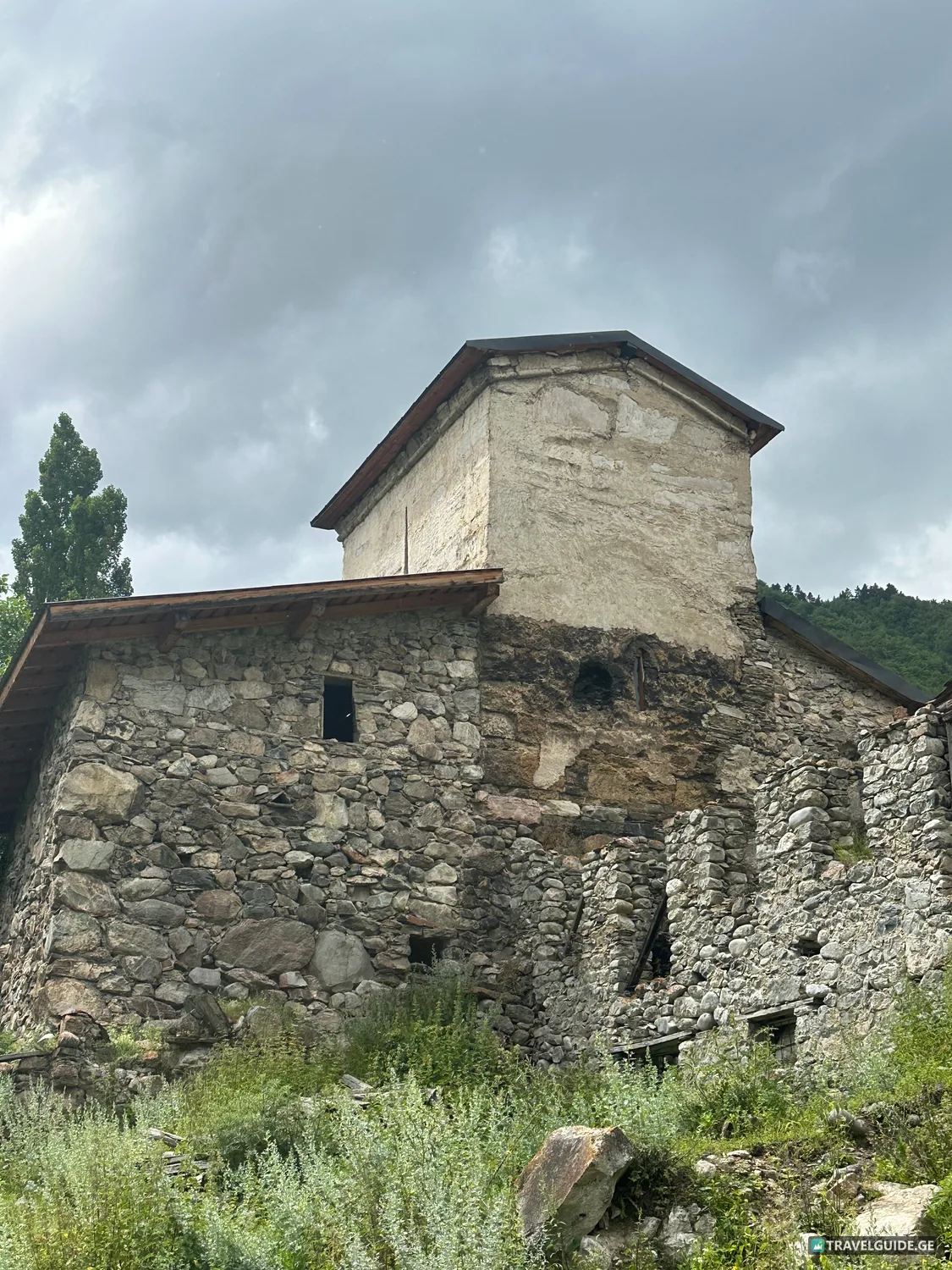
The Lekhtagi neighborhood represents a remarkably preserved stratum of Mestia’s urban development, functioning as a silent witness to the evolution of Upper Svaneti. Situated away from the concentrated tourist infrastructure of Seti Square, this district maintains a dense cluster of traditional architecture that reflects the social and defensive strategies of the Svanetian highlanders during the Middle Ages. At the nucleus of this settlement stands the Lekhtagi Lamaria, a church consecrated to the Dormition of the Virgin Mary. In the local lexicon, the term Lamaria acts as a linguistic bridge, honoring the Mother of God while preserving ancient, pre-Christian connotations associated with the veneration of divine feminine figures in the high Caucasus.
Physically, the site occupies a strategic vantage point within the village, surrounded by a tight-knit arrangement of domestic dwellings and defensive koshki (towers). These structures form a coherent ensemble that illustrates how medieval life in Svaneti was structured around the twin requirements of theological devotion and physical security. The surrounding environment remains largely defined by the agricultural layout of the past, with the church acting as a gravitational center for the community’s historical memory.
Historical Significance and Foundation
The origins of the Lekhtagi Lamaria are traced to the 10th–12th centuries, a period characterized by a surge in ecclesiastical construction across the Svanetian highlands. This era marked the solidification of the Orthodox faith, yet the construction techniques reflect a distinct regional approach—using locally sourced materials to create structures capable of enduring the extreme environmental pressures of the Greater Caucasus. Unlike the monumental cathedrals of the lowlands, this church was engineered to be durable, understated, and functionally integrated into the fortified lifestyle of the highland clans.
Architecture and Material Composition
- Structural Form: A single-nave hall church, adhering to the standard architectural canon of medieval Svaneti.
- Materiality: The load-bearing walls are constructed from roughly hewn limestone and shale blocks. These materials have weathered over centuries to achieve a natural grey-brown patina that harmonizes with the surrounding mountain slopes.
- Defensive Integration: The church is situated in close proximity to a Murkvam (traditional Svan defensive tower) and retains remnants of a stone enclosure wall. This juxtaposition confirms that the site served as a multi-purpose sanctuary—a place of liturgical assembly that could rapidly transition into a defensive perimeter during regional conflicts.
The Interior and Medieval Frescoes
The interior of the Lekhtagi Lamaria is defined by its austere, meditative scale. The walls provide a surface for a sophisticated program of frescoes dating from the 11th to 12th centuries, which remain critical for understanding the development of the Svanetian school of monumental painting. The artists utilized a robust palette, primarily consisting of ochre, hematite red, and mineral-based blues, to render iconography that is simultaneously theological and profoundly local. The figures depicted are characterized by intense, direct gazes, often interpreted by art historians as an artistic manifestation of the resilience and focused discipline required for high-altitude existence.
Socio-Cultural Role of the Site
Beyond its role as a religious building, the church acts as a repository for local folklore and lineage histories. Many of the families in the Lekhtagi district hold ancestral ties to the site, viewing it not just as a historical monument but as an active component of their community identity. The persistence of these structures, often managed and protected by private families for generations, is a phenomenon central to the cultural survival of Svaneti. The church serves as a physical link between the contemporary residents of Mestia and the historical clans who established the foundational defensive and religious framework of the region.