
Saint Ilarion Kartveli Church in Mestia
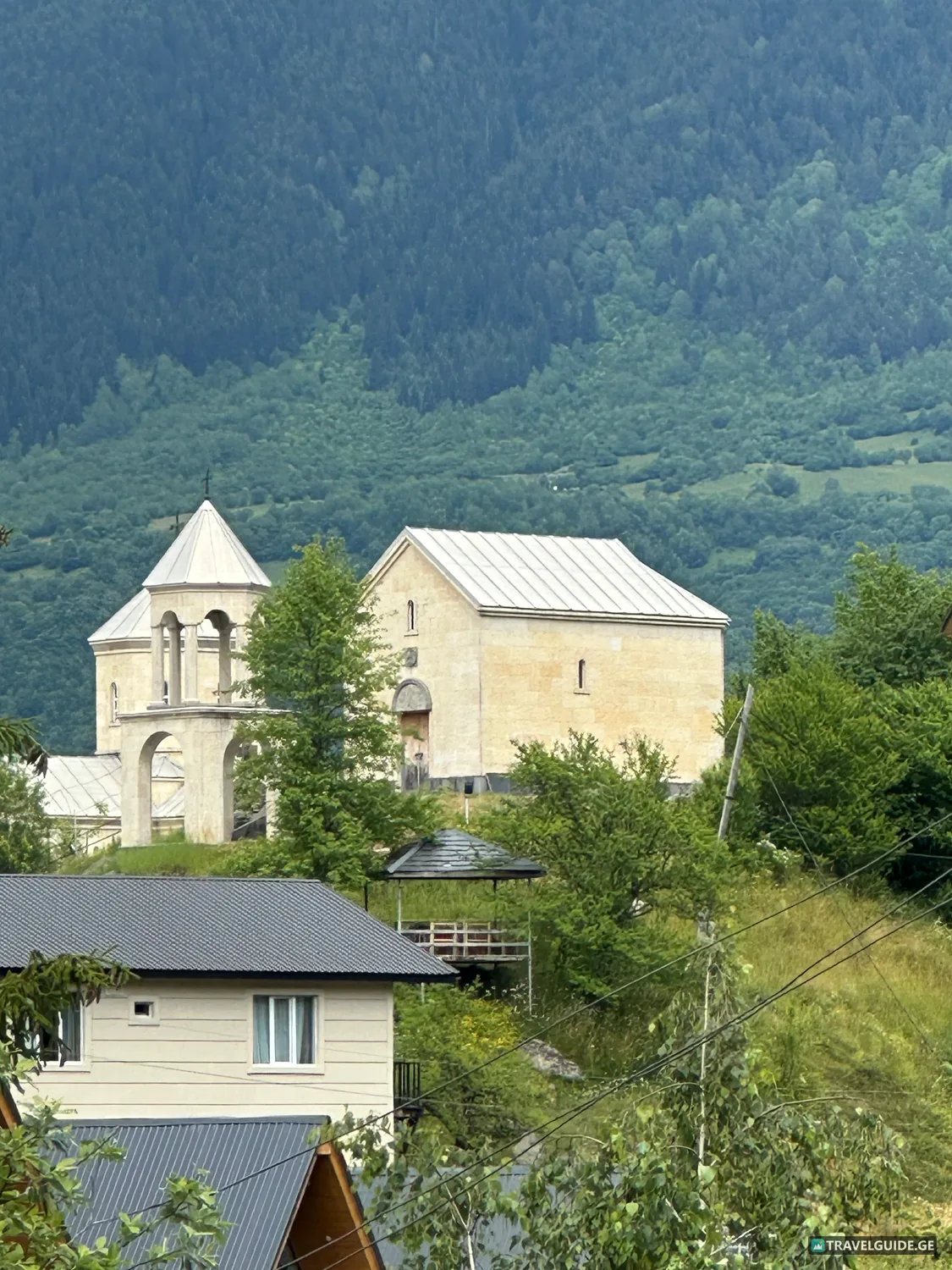
Positioned firmly in the central urban grid of Mestia, where the convergence of the Mestiachala and Mulkhra river valleys creates a dramatic alpine basin, the Saint Ilarion Kartveli Church anchors the spiritual life of Upper Svaneti. Overshadowed by the stark, jagged summits of Mount Ushba and Mount Tetnuldi, this structure stands apart from the isolated, high-altitude shrines that require arduous mountain treks to access. Instead, this sanctuary exists in the immediate, daily periphery of the local highland population. It represents a vital continuity of Orthodox Christian faith deeply embedded within a geographical zone famous for its fierce independence and distinct ethno-cultural identity. The physical landscape surrounding the church is defined by the imposing silhouette of medieval Svan defensive towers, creating a spatial environment where secular fortress architecture and sacred stone sanctuaries exist in perpetual dialogue.
The dedication of this specific structure to a renowned 9th-century monk highlights a deliberate cultural linkage. Upper Svaneti, geographically protected by the impenetrable walls of the Great Caucasus Range, often developed its religious traditions in intense isolation, which occasionally led to a unique synthesis of early Christian dogma and older mountain belief systems. The establishment of this church brought a specific focus to one of the most widely traveled and intellectually significant Georgian religious figures. By anchoring his name in Mestia, the local highlander community became firmly tethered to the broader ecclesiastical movements of the medieval Georgian kingdom and the expansive Byzantine world.
Through its continuous, quiet operation, the church functions as a living archive of Svan religious adherence. The air within the stone enclosure resonates with centuries of liturgical practice, preserving an unbroken line of worship that survived empires, brutal regional invasions, and modern geopolitical shifts. The stonework itself bears the literal and figurative marks of time, reflecting a deeply pragmatic approach to ecclesiastical architecture where structural resilience against brutal alpine winters was prioritized over external ornamentation.
The Monastic Legacy of Saint Ilarion the Georgian
To comprehend the philosophical foundation of the church, one must examine the life of Saint Ilarion Kartveli (Ilarion the Georgian). Born into an aristocratic family in the eastern region of Kakheti in 822 AD, Ilarion chose to abandon his inherited secular privilege in pursuit of radical asceticism. His ecclesiastical journey began at the remote monastic complex of David Gareja, but his pursuit of theological enlightenment eventually drove him far beyond the borders of the Caucasus.
Ilarion became a definitive figure of Georgian monasticism by traveling across the known Christian world. He established and reformed monastic communities on Mount Olympus in Bithynia, engaged in theological discourse in Constantinople, and made significant pilgrimages to Rome. His extensive travels effectively served as a dynamic cultural bridge, integrating Georgian theological thought with the intellectual currents of the Byzantine Empire and the West. In Upper Svaneti, dedicating a central sanctuary to him serves as a geographical paradox: a profoundly isolated mountain community honoring a saint defined by his boundless global movement and cross-cultural engagement.
Vernacular Architecture and Material Composition
From an architectural standpoint, the building is a masterclass in the traditional Georgian hall-church, or darbazi, typology. This architectural style was explicitly adapted by local masons to survive the severe, unforgiving climate of the high Caucasus. Unlike the grand, multi-domed cathedrals of the lowlands, this structure utilizes a straightforward, monolithic profile designed for ultimate endurance.
The structural integrity of the church relies on several specialized mountain building techniques:
- Thermal Mass Construction: The walls are constructed using exceptionally thick, locally quarried schist and limestone, bound by indigenous mortar recipes designed to retain heat from candles and congregants during the sub-zero Caucasian winters.
- Minimalist Fenestration: The windows are deliberately narrow, resembling defensive arrow slits rather than traditional cathedral windows. This design minimizes heat loss while casting highly focused, dramatic beams of natural light directly onto the altar and iconostasis.
- Steep Pitched Roofing: The original roof lines are steeply angled and clad in heavy stone slates, an engineering necessity designed to efficiently shed the massive snow loads that accumulate in Mestia between November and April.
- Acoustic Engineering: The interior vaulting creates a highly specific acoustic environment, engineered to naturally amplify the distinct, resonant frequencies of traditional Georgian polyphonic chanting without the need for vast architectural volume.
Liturgical Significance and Iconography
The interior of the church presents a stark, intimate atmosphere that demands contemplation. The absence of overwhelming natural light draws immediate attention to the gilded surfaces of contemporary and historical icons lining the unadorned stone walls. The visual language inside the church is deeply tied to the sensory experience of Orthodox worship—the persistent scent of burning beeswax, the lingering haze of frankincense, and the visual warmth of candlelight illuminating the faces of saints.
Religious practice in Svaneti often involves an intense, highly localized form of devotion, and this church serves as the primary epicenter for that daily ritual in Mestia. It is the site where the high-register intricacies of Georgian ecclesiastical music merge with the rugged, baritone foundations of Svan polyphony during major feast days. The sanctuary operates not as an inert historical monument, but as an active, breathing organism where the spiritual and physical realities of life in the high Caucasus intersect daily.