
Holy Trinity Cathedral of Tbilisi (Sameba)
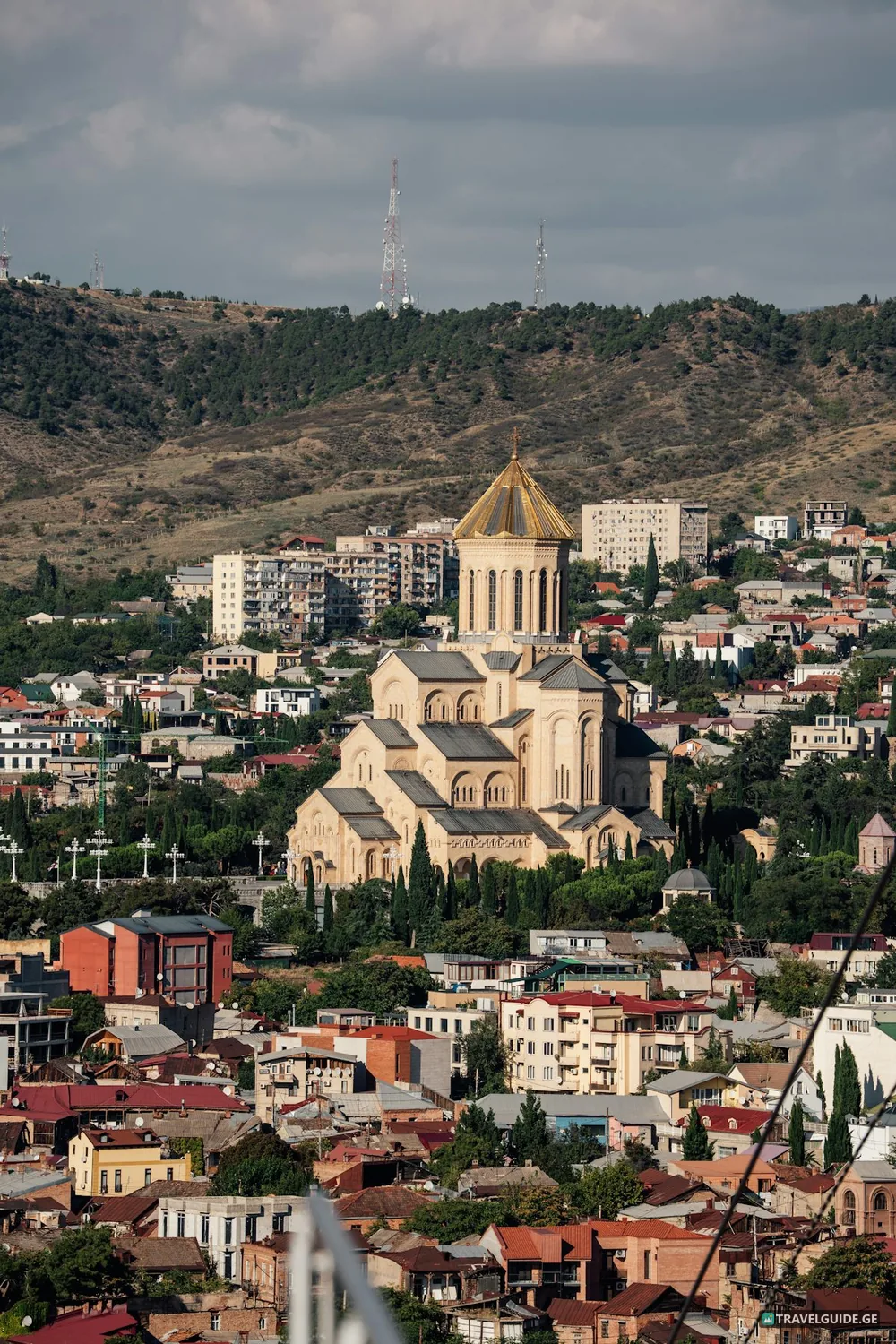
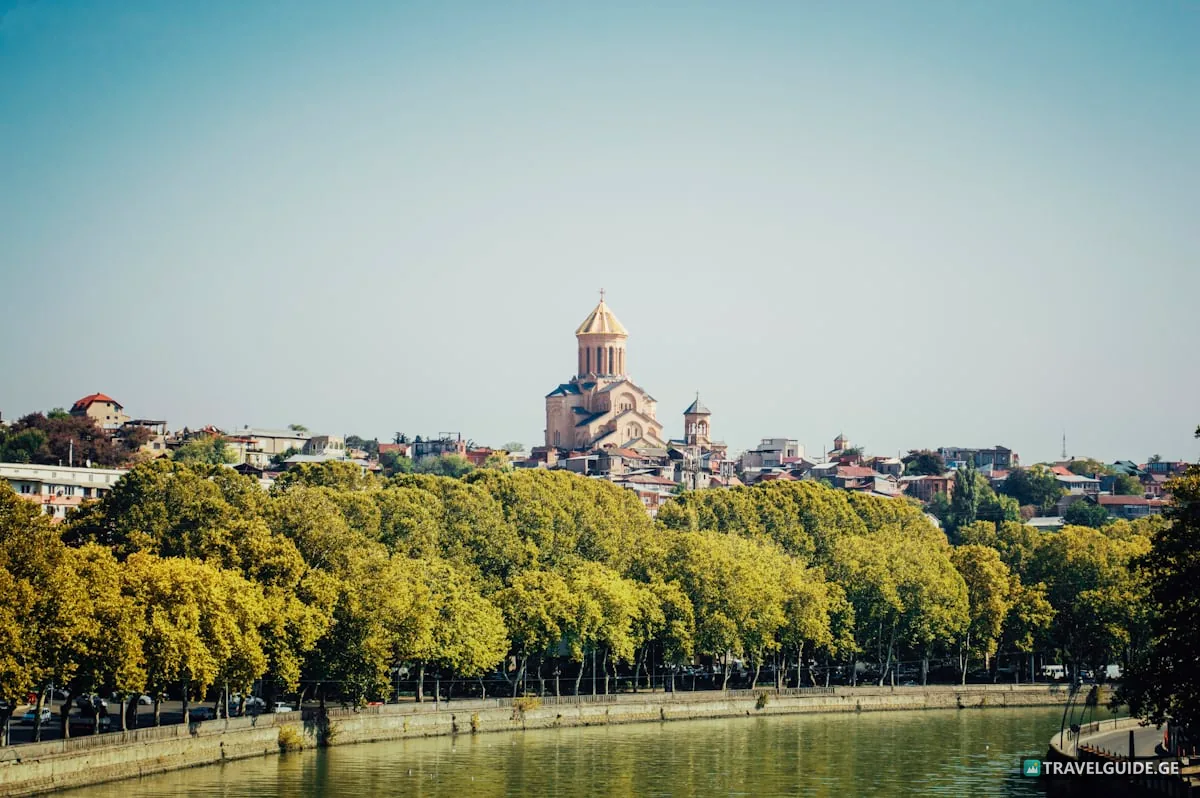
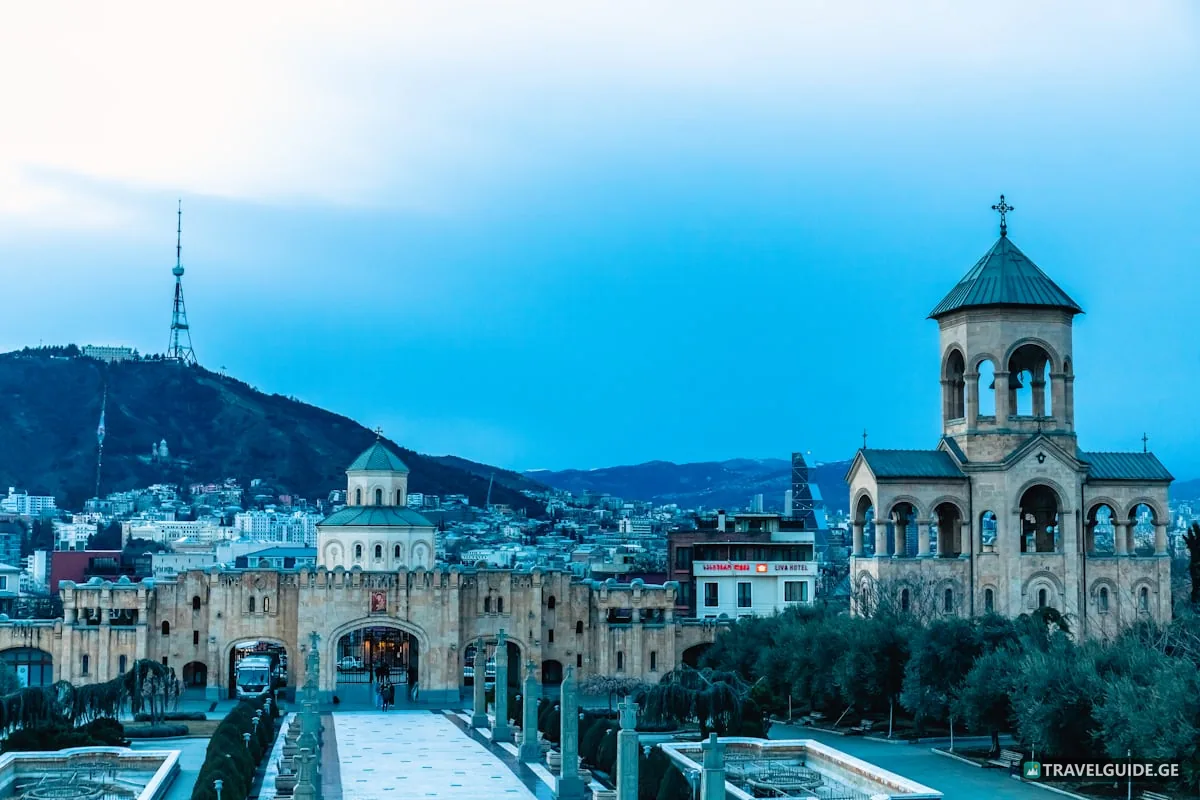
From almost every high point in Tbilisi the gold cross on Elia Hill catches the eye. It belongs to Sameba, the cathedral that redefined the city’s skyline after 2004. The scale is disarming up close. The dome rises 86.1 meters to the top of the cross, the cross itself is 7.5 meters tall, and if you count the foundation depth the total structural height reaches 100.17 meters. That makes it the third-tallest Eastern Orthodox cathedral in the world and one of the largest religious buildings by total area, around 5,000 square meters.
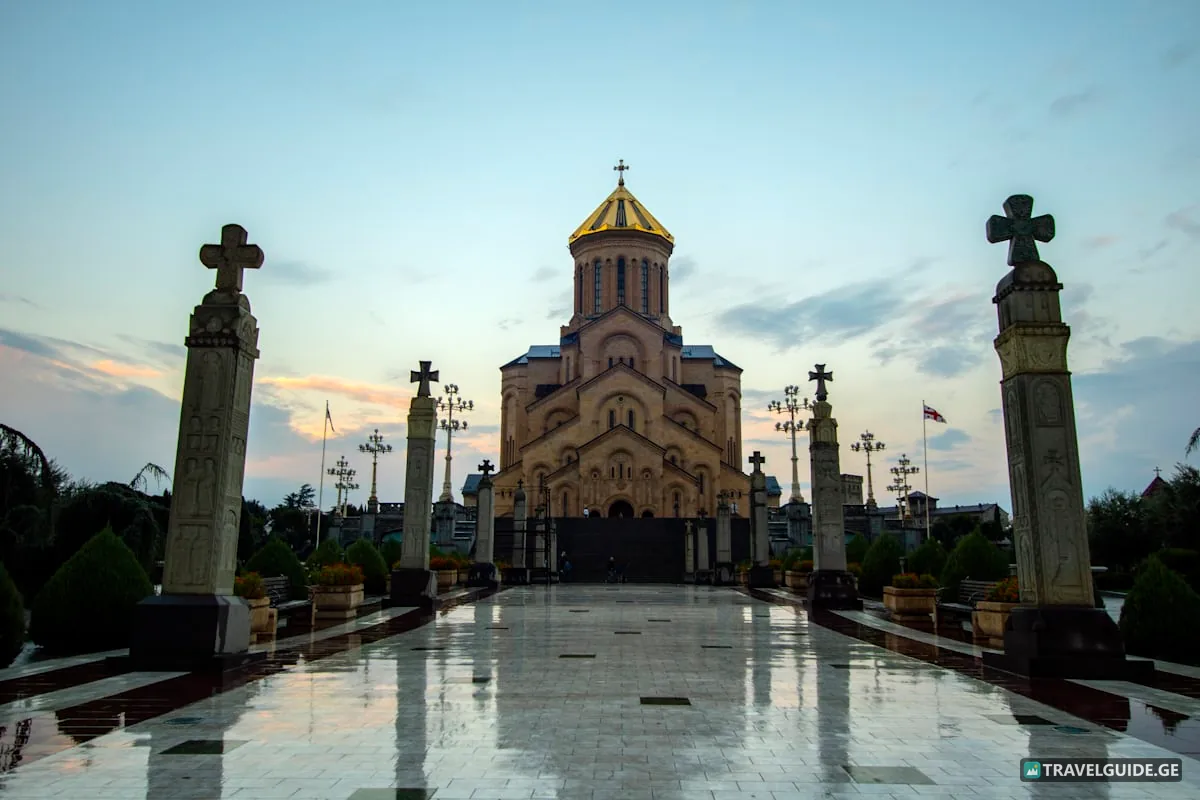
The site was not accidental. Elia Hill looks over the left bank of the Mtkvari in Avlabari, the historic district that faces the old town across the river. The position gives the cathedral a natural dominance. From the courtyard you see Metekhi, Narikala, the Presidential Palace and the dense tiled roofs of Old Tbilisi. At dusk the stone turns warm and the gilded dome reflects the last light. That is the moment most photographers wait for.
Origins and a delayed start
The idea emerged in 1989. The Georgian Orthodox Church was approaching 1,500 years of autocephaly and the Christian world was approaching 2,000 years since the birth of Jesus. A new national cathedral was proposed as a symbol of revival. An international competition was announced in May 1989. More than a hundred projects were submitted. No winner was chosen in the first round. The design by architect Archil Mindiashvili eventually prevailed.
History intervened. The early 1990s brought civil unrest and economic collapse. The project stalled for six years. The foundation stone was finally laid on 23 November 1995, St George’s Day, a date with deep resonance in Georgia. Construction was funded largely by anonymous donations from businessmen and ordinary citizens. It became a collective undertaking. After nine years of work the cathedral was consecrated on 23 November 2004 by Catholicos-Patriarch Ilia II, with representatives of other Orthodox churches and other faith communities present.
The location has been contested. Part of the complex occupies land that once belonged to the old Armenian cemetery of Khojavank. The cemetery had already been heavily damaged in the Soviet period, when the Armenian church on the site was demolished on the orders of Lavrentiy Beria and the area was turned into a park. During the Sameba excavations human remains and broken gravestones were uncovered, which provoked criticism and lasting debate about heritage and memory in Avlabari.
Architecture between tradition and monumentality
Mindiashvili worked in the Georgian cross-dome tradition, but he pushed the vertical emphasis further than medieval builders could. The plan is cruciform. The dome rests on eight columns and is independent from the apses, which gives the whole volume a more monumental, almost free-standing character. The exterior is clad in a mix of natural materials: light stone, Bolnisi tuff, marble and granite. The texture changes with the light. Close up you can trace the fine stone carving around the portals, motifs drawn from medieval Georgian bas-reliefs, often missed by visitors who only look up.
The proportions are large: length about 70.4 meters, width about 64.7 meters. The interior area is around 3,000 square meters, with exterior stairs and platforms adding more. The floor is marble. The altar area is intended for mosaic decoration. Mural painting has been carried out under the direction of artist Amiran Goglidze and continues in parts of the complex. The iconostasis and the furnishings combine traditional wood carving with a restrained contemporary sensibility. The space feels deliberately uncluttered for a building of this size. Sound travels well. During services the choir fills the dome without amplification.
Nine chapels and two levels
Sameba is not a single hall. The cathedral contains nine chapels dedicated to the Archangels, John the Baptist, Saint Nino, Saint George, Saint Nicholas, the Twelve Apostles and All Saints. Five of them are located in the large underground level. The underground church is a complete liturgical space in its own right, lower, cooler and more intimate than the main nave above. The foundation goes 14.07 meters deep, the floor of the lower level sits at 13.07 meters below the zero level. Pilgrims often light candles downstairs first, then ascend to the main church.
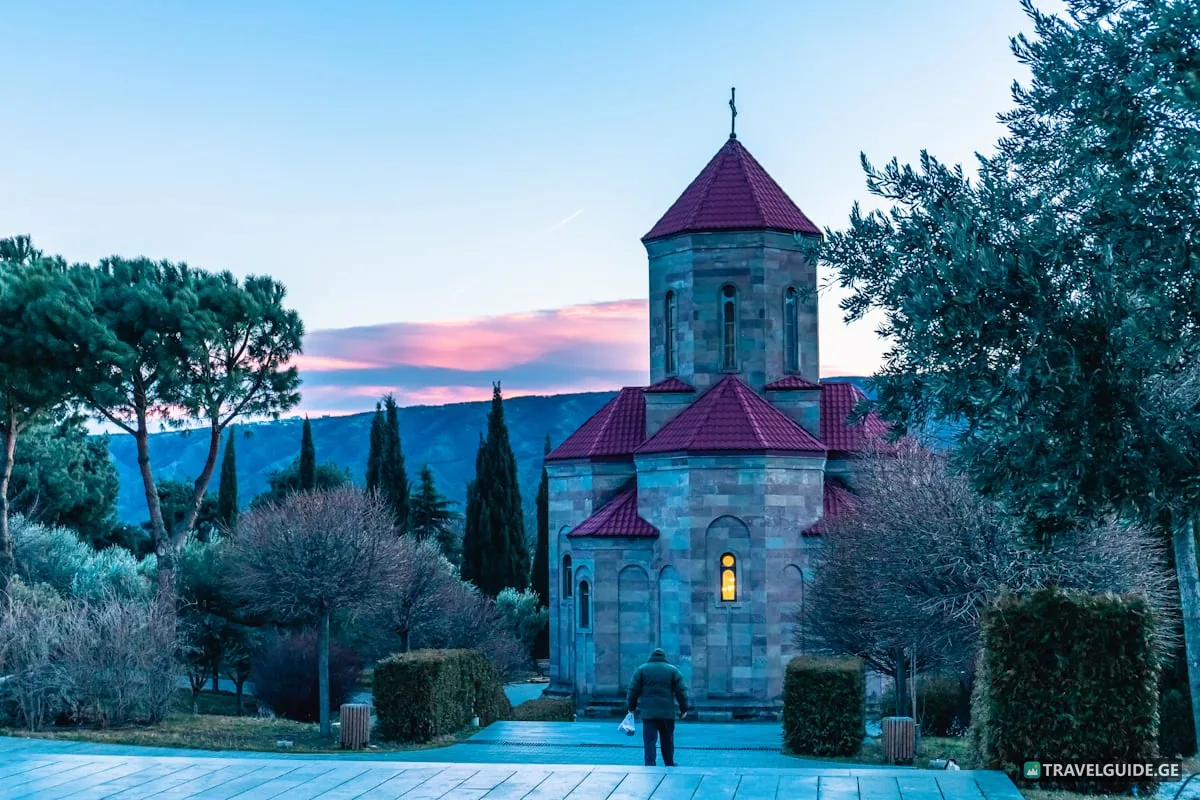
The complex as a whole is more than the cathedral. On the terraced grounds stand a free-standing bell tower, the residence of the Patriarch, a monastery, a clerical seminary and theological academy, workshops and quiet resting places. The layout is axial and symmetrical, with broad staircases and wide terraces that handle large crowds on major feast days. On ordinary days the courtyards are calm. You will see people sitting on benches, children playing at a respectful distance, and priests moving between buildings.
What it feels like to visit
The approach matters. You climb the hill, the city noise drops away, and the cathedral grows in the frame. The first impression is of sheer verticality. Then you notice the details: the bronze doors, the carved stone bands, the subtle color variation in the masonry. Inside, the light is filtered and soft. The dome is high enough that the eye needs a moment to adjust. Icons are placed at human scale along the walls. The most venerated images attract small queues of people who kiss the frame and cross themselves.
Photography is restricted inside the main nave, especially during services. Outside, the best angles are from the lower terraces looking up, and from the side platforms where you can include the bell tower in the composition. Early morning gives a clean, cool light on the east facade and the gold cross catches the first sun. Late afternoon brings long shadows across the stairs. After sunset the cathedral is floodlit, and the dome glows against a dark sky.
Etiquette and practical notes
Dress code is enforced. Women are asked to cover their heads and wear skirts below the knee. Men should wear long trousers. Scarves and wrap-around skirts are provided at the entrance if you arrive unprepared. Silence is expected inside. Mobile phones should be muted. It is customary to buy candles at the small kiosks in the courtyard or in the narthex. You light them in front of the icons of your choice.
The site is free to enter. Opening hours are generous, typically from early morning until late evening, with longer hours on feast days. Services take place daily. The most atmospheric times are early morning liturgy and evening vespers, when the bells ring out over Avlabari. If you prefer quiet, come on a weekday mid-morning.
The grounds are spacious and mostly paved with gentle ramps and stairs. Comfortable shoes help. There is a small garden area with benches where you can sit and look over the city. Vendors do not operate inside the complex. Bring water in summer; the stone reflects heat.
Recent history in the public eye
In January 2024 an icon depicting Saint Matrona of Moscow blessing Joseph Stalin was discovered inside the cathedral. The image, donated by members of the conservative Alliance of Patriots of Georgia, sparked public debate about historical memory and the place of Soviet symbols in a church. The icon was defaced with blue paint on 10 January, an incident that drew national press attention and protests. The episode underlined how Sameba functions not only as a place of worship but as a focal point for national conversation.
Why the cathedral matters
For many Georgians Sameba is inseparable from the post-Soviet revival of the church and of national identity. It was built at a moment when the country was redefining itself. The scale, the hilltop position and the visibility from across the city make it a constant reference point. For visitors, it offers a clear entry into Georgian Orthodox architecture without needing to travel to the medieval sites in the regions. The synthesis of traditional forms with modern engineering is explicit here.
Exploring the immediate surroundings
After you have walked the terraces, the natural continuation is down into Avlabari. The neighborhood retains narrow streets, 19th-century houses with carved wooden balconies, and small courtyards. The Presidential Palace, with its distinctive glass dome, stands nearby on the same ridge. It is an interesting contrast of contemporary state architecture next to a church that references the Middle Ages.
From Avlabari you can continue toward Rike Park on the riverfront. From there a cable car climbs to Narikala Fortress. The view back toward Sameba from the fortress is one of the classic panoramas of Tbilisi: the golden dome rising above the dense city, with the Caucasus foothills beyond. Metekhi Church, perched on a cliff over the Mtkvari, is also within walking distance and provides another historic counterpoint to Sameba’s modern monumentality.
Tips for a good visit
Give yourself time. One and a half to two hours is enough for the cathedral and the courtyards, longer if you want to sit and observe. Come early for soft light and fewer people, or come at sunset for the most dramatic sky. Check the liturgical calendar; major feasts such as Easter, Christmas on 7 January, and St George’s Day on 23 November bring large crowds and a powerful atmosphere, but also limited space to move.
Respect the space. Even if you are not Orthodox, the building is actively used for prayer. Walk slowly, keep voices low, and avoid crossing directly in front of people who are praying. If you want to attend a service, stand at the sides or back. There is no seating in the nave; worshippers stand.
Sameba rewards patience. The first glance gives you the skyline. The second gives you the stonework. The third gives you the life of the place: candles being lit, quiet conversations in the courtyard, bells marking the hour over Tbilisi. That combination of monument and daily practice is what stays with visitors after they leave Elia Hill.