
David Gareja Lavra
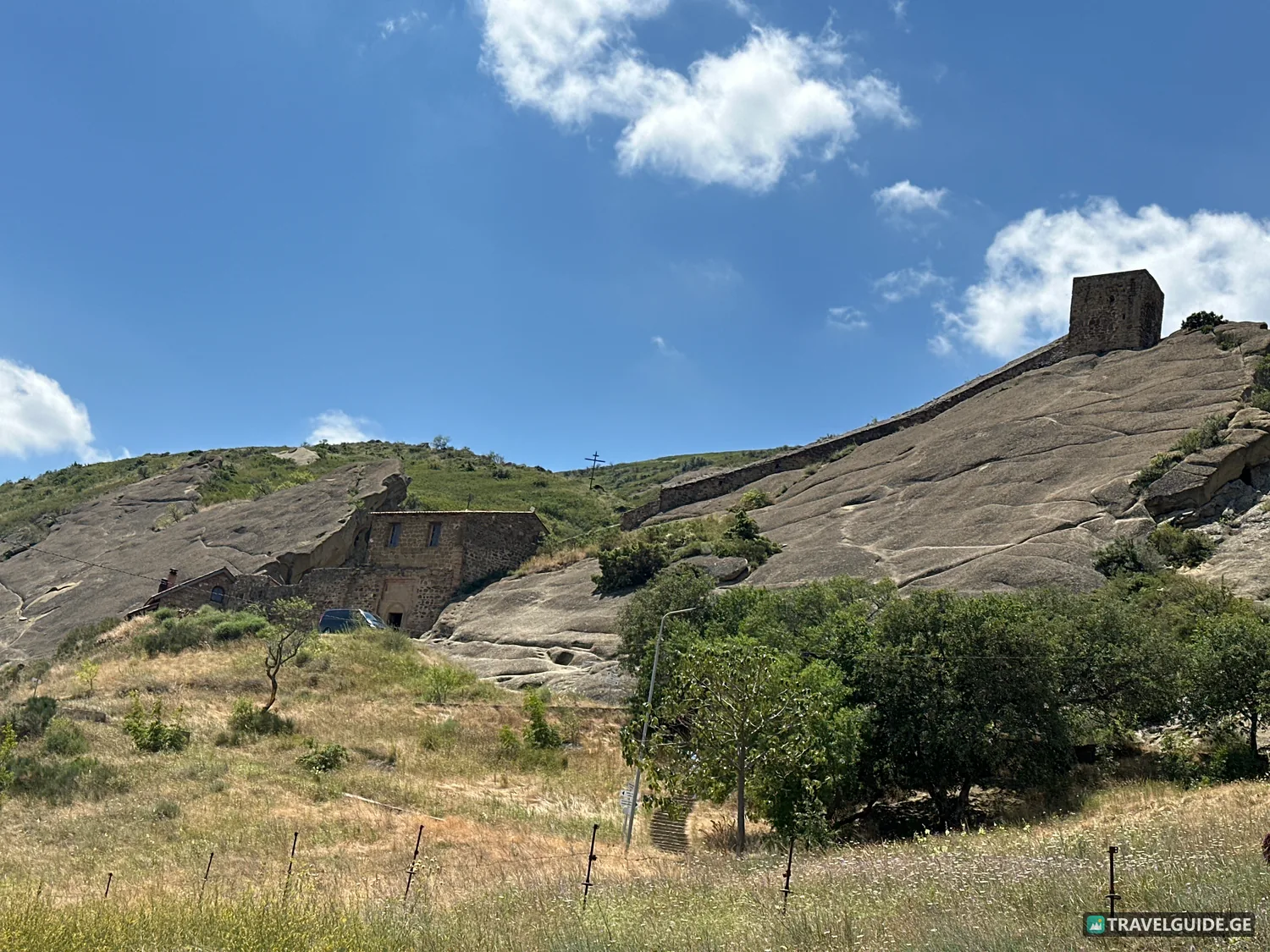
Situated on the arid, wind-sculpted slopes of Mount Gareja within the broader Iori Plateau, the David Gareja Lavra forms the ancient core of Georgia’s most significant monastic network. Carved directly into the precipitous sandstone cliffs, this ascetic enclave emerged in the 6th century under the guidance of St. David Garejeli, one of the renowned Thirteen Assyrian Fathers. The environment is harsh and unyielding, characterized by a semi-desert landscape that deeply reflects the austere spiritual philosophy of its early inhabitants.
The geography surrounding the monastery is as spiritually significant as the architecture itself. The vast, undulating plains stretching toward the modern-day border with Azerbaijan isolate the complex from the verdant valleys of central Georgia. This intentional isolation served as a physical barrier against secular distractions, allowing the monks to cultivate an environment of absolute devotion. The rock face, composed primarily of porous sedimentary stone, provided both the canvas and the sanctuary for centuries of theological scholarship.
Throughout the medieval period, the Lavra evolved from a modest hermitage into a thriving epicenter of Christian education, manuscript illumination, and ecclesiastical art. Its prominence peaked during the Georgian Golden Age in the 11th and 12th centuries, attracting thousands of ascetics. Despite enduring devastating invasions by the Mongols in the 13th century and Shah Abbas I of Persia in 1616—who martyred a significant portion of the monastic population—the site has maintained its status as a cornerstone of Georgian Orthodox identity.
The Architectural Morphology of the Lavra
The structural composition of the David Gareja Lavra is entirely dictated by the geology of the cliffside. Unlike traditional freestanding masonry churches, the builders here employed subtractive architecture, excavating living rock to form voids that served as chapels, refectories, and individual cells. The spatial arrangement reflects a profound understanding of the natural topography.
- The Main Courtyard: A central gathering space defined by tiered terraces and defensive walls added during later medieval periods to protect against continuous regional incursions.
- St. David's Tomb: The central spiritual focal point of the complex, housing the remains of the founding father beneath a remarkably unadorned stone canopy within the main church.
- Water Management Systems: A complex, vital network of carved channels and cisterns designed to capture scarce rainwater, an absolute engineering necessity in the arid climate of the plateau.
Evolution of Garejian Frescoes
The interior walls of the excavated chapels display a highly distinct school of mural painting that diverged significantly from Byzantine norms. The Garejian School of Painting is characterized by dynamic linear expressions, uniquely Georgian facial typologies, and a specific color palette derived from local mineral pigments.
- Early Period (8th-10th Centuries): Minimalist, monochromatic outlines emphasizing raw spiritual intensity and theological messaging over anatomical realism.
- Golden Age Flourishes (11th-13th Centuries): The introduction of vibrant lapis lazuli and red ochre, featuring complex iconographic programs including detailed depictions of royal figures like Queen Tamar and King David the Builder.
- Post-Invasion Resilience: Later additions showing more subdued, rigid styles, directly reflecting the economic and cultural decimation following the devastating Persian campaigns.
Geological and Ecological Context
The bedrock of the region consists of heavily stratified sandstone and mudstone. This specific lithology allowed for relatively straightforward excavation using early medieval iron tools, facilitating the rapid expansion of the complex. However, this same geological softness renders the site highly vulnerable to seismic activity and ongoing wind erosion, which constantly reshapes the facade of the cliffs.
The surrounding biome is defined by the Shiraki Plain and the Iori River basin, supporting hardy flora such as arid scrubland vegetation. It sustains rare species of desert-adapted fauna, including the Levantine viper and various birds of prey like griffon vultures, which utilize the thermal currents rising from the cliff face. This rugged ecosystem remains largely unchanged since the era of the early ascetics.